EXPLAIN – World Patient Safety Day 2025

EXPLAIN – World Patient Safety Day 2025

Wednesday 17 September 2025 is World Patient Safety Day. On this day, healthcare professionals, researchers, and others work to increase global awareness and action on patient safety.

However, patient safety is a year-round commitment and is always at the forefront of the clinical trials that are managed across the UK and beyond by Clinical Trials Units (CTUs) registered by the UKCRC Registered CTU Network.

Registered CTUs devise and manage many clinical trials that collectively cover patients and participants with multiple diseases/conditions and/or injuries at all ages. 

Find out more about the work of registered CTUs here.

In order to promote a greater understanding of patient safety amongst research participants, three of the CTUs in the Network – the Nottingham Clinical Trials Unit, the Centre for Clinical Trials Research, Cardiff University, and the Oxford Clinical Trials Research Unit – have, in collaboration with patients and their representative, produced a short animation explaining how safety is overseen in clinical trials.

Please visit the EXPLAIN project website https://explain.octru.ox.ac.uk to watch the animation. The page includes a link to request a copy of the animation for use in any research in any of six different language options. There are also explainer animations covering consent and randomisation.

Click here to find out more about the work of the Network.

Response from UKCRC Registered CTU Network on the Industrial Strategy and the Life Sciences Sector Plan

We strongly welcome the new UK Industrial Strategy and associated Life Sciences Sector Plan which recognise the value to the health and wealth of our communities of life sciences and clinical trials. This is a sector which creates high value jobs, whilst simultaneously driving to improve our lives through living longer better. The recognition of the importance of long term relationships with industry, talent management and more risk proportionate regulation are key parts of our strategy as a network as well as enhancing how we maximise the use of existing data in driving forward our science.  As a UK wide network with members in all four nations of the UK, who themselves design and run UK wide (and international) clinical trials, the commitment to UK wide joint working both strategically and operationally is excellent news. 

There are a number of areas that we would like to see developed further however – the importance of commercial collaborative trials being a key one.  These trials, including what have been known as investigator-initiated trials (IIT), which are fully or partially funded by industry but led by an NHS or University sponsor are a core part of our ongoing partnership with industry.  They represent opportunities for derisking the testing of new or existing drugs for a wider range of conditions than a company is targeting.  These then may or may not lead to licensing or license changes depending on the results of the trial.  In the past we have seen initiatives like the Cancer Research UK and AstraZeneca (AZ) Combinations Alliance which offered up drugs and some joint funding to researchers who wanted to test them in cancers which were not the target for the commercial trials supported by AZ.  One of these trials evaluated the use of Capivasertib for breast cancer and following this was approved by NICE in 2025 and is now being used to treat patients. We also need to explore how we more optimally work with industry in sharing our trial methodology expertise and this will be part of what we are aiming to do across our network in the near future.

We are delighted to see clarity on the streamlining of regulation, although it is important that we recognise risk proportionality for all entities involved in a regulatory process, not a shifting of burden from one sector to another.  Processes need to be proportionate for industry, for regulators, for researchers and for NHS organisations trying to implement the research. For example recent legislative changes to bring in notifiable trials are very welcome, but operationally, this is only proportionate for the MHRA who will not have to give approval, but that everyone doing a notifiable trial will be expected to have the same level of documentation upon inspection. To truly deliver reduced (but appropriate) regulatory burden in this area we need to move to a shared understanding of risk proportionality.

The other two areas that we feel are under covered in this plan are the importance of clinical academics and how trials can support subsequent implementation of interventions.  Clinical academics are essential in delivering a strong life sciences sector which can make a difference for the NHS and the public.  Considering how we develop these individuals and roles in a three-way relationship between academia, NHS and industry would build on recent Office for Strategic Coordination of Health Research (OSCHR) reports (link) and support longer term partnership building across the three sectors. Similarly, many academic led trials incorporate considerable aspects of implementation research (such as process evaluations) and these inform the operational implementation of an intervention in the NHS over and above any regulatory or procurement processes.  In designing an eco-system it is important to remember this connected opportunity rather than establishing separate systems and processes.

Overall there is a lot that is good here, but also plenty for us all to work on to shape the future of life sciences in the UK and we look forward to working in partnership to deliver this vision.

Read the Life Sciences Sector Plan here.

New PeRSEVERE Paper Published

New Paper Describes the Development of the PeRSEVERE Principles & Guidance

The PeRSEVERE project was started within the UKCRC Registered CTU Network in 2019 to address the lack of detailed guidance for managing ‘withdrawal’ of consent and other participation changes in our trials.

Participation changes can be complex, and it can be unhelpful to view them as binary – i.e. to view the only possible participation statuses as ‘taking part’ or ‘withdrawn’.

Motivated by what they thought shouldn’t be happening in their trials, a multi-disciplinary group came together to try to agree how participation changes should be managed.

A new paper published by the project group, entitled Standardising management of consent withdrawal and other clinical trial participation changes: The UKCRC Registered Clinical Trials Unit Network’s PeRSEVERE project describes how they developed the PeRSEVERE principles through discussion and debate within a large, multidisciplinary collaboration, including research professionals and public contributors.

The team took an inclusive approach to drafting the principles, incorporating new ideas if they felt they were within the project scope. The draft principles were then scrutinised through an international consultation survey which focussed on the principles’ clarity, feasibility, novelty and acceptability.

After finalising PeRSEVERE guiding principles, we developed accompanying implementation guidance using several sources such as the SPIRIT/CONSORT statements.

The principles and all accompanying guidance and resources are available at https://persevereprinciples.org/.

Previous publications arising from the PeRSEVERE project can be found here:

– A paper about their guidance and how it was developed with a group of public contributors

– A paper reporting the results of a survey of REC members for their views on the communications guidance

Red4Research 2025: Celebrating Healthcare Innovation

Launched in 2020, and now in its sixth year, the campaign continues to champion the critical role clinical research plays across all areas of healthcare.

The importance of clinical research has remained firmly in the spotlight since its launch. As the Department of Health and Social Care (DHSC) reiterates, research remains one of the most powerful tools we have to drive progress in healthcare—helping us to prevent, diagnose, and treat disease more effectively.

We are encouraged by continued government recognition of the value of research, affirming the UK’s commitment to clinical research excellence and our position as global leaders in early-stage and academic-led research.

We were delighted to see plans to speed up clinical research announced recently and are looking forward to the upcoming 10 year health plan!

https://www.gov.uk/government/news/unprecedented-boost-for-clinical-trials-under-10-year-health-plan

As experts independently assessed in high quality trial design, conduct, and reporting, CTU Network members are exceptionally well placed to support these ambitions and we continue to engage with policy makers, funders, and regulators on how to drive innovative research forward.

In 2025, Red4Research continues to spotlight and celebrate the dedication of everyone involved in clinical research—from participants and volunteers, to coordinators, clinicians, and support staff. Their work underpins the UK’s position as a global leader in health research and continues to transform care for patients and their families.

Marking One Year of Commitment to Environmental Sustainability in Research

As we approach World Environment Day on 5th June, we are proud to mark one year since becoming a Supporter of the Concordat for the Environmental Sustainability of Research & Innovation Practice. This milestone highlights our ongoing dedication to embedding environmental sustainability throughout the clinical trials landscape.

In signing the Concordat, we committed to action across three key priority areas: leadership and system change, emissions from academic travel, and collaborations and partnerships.

Leadership and system change

We recognise that long-term research quality and impact depends on sustainable practices.

Over the past 12 months, we have been developing our Strategy for 2025–2030, ensuring that sustainability is not only reflected but embedded within our long-term goals. Our commitment to responsible, environmentally conscious research remains central to our strategic direction and future ambitions.

The Network also supports strengthening business models for long-term resilience while embedding environmental sustainability in all activities.

Read more about our strategy here.

Reducing emissions from academic travel

As a Network, we have reduced the number of face-to-face national meetings and transitioned to providing digital materials for all our events.  Where possible we combine meetings to remove the need for multiple journeys.

We have expanded our programme of webinars, roundtables, and discipline-specific online clinics, enabling more CTU staff to access shared learning and peer support without the need for travel. This shift has not only lowered our environmental impact but also greatly improved accessibility and inclusivity across the Network. 

In the last 12 months, our online programme has included 5 clinics, 6 webinars, 12 roundtables, and 15 user group meetings – allowing around 1200 people to share their knowledge and experiences without additional travel.

Collaborations and partnerships

Through collaboration and knowledge-sharing, we are supporting CTUs in advancing sustainable research practices — both by improving current systems and processes, and by exploring innovative approaches for the future.

Joint initiatives focused on simplifying and decentralising trials, harnessing emerging tools like AI, and promoting remote alternatives for activities such as trial monitoring, enable our members to benefit from shared expertise. This collective approach helps reduce duplication of effort and resources, driving more efficient and environmentally conscious research.

We are also proud to play our part in the work of wider groups in developing policies and practices that support our sustainability goals.  This includes supporting the development and piloting of a carbon footprinting tool for clinical trials, led by two of our member CTUs in as part of the TMRP’s Greener Trials Group.

The future

We look forward to continuing our collaborative efforts to advance more sustainable clinical research over the next 12 months and beyond.

Together we can make a difference!

Find out more

~ To learn more about the aims and ambitions of the Concordat click here.
~ To download the Network’s official letter of support from 2024 please click here.
~ You can find out more about World Environment Day, and this year’s call for collective action to tackle plastic pollution, here.
Celebrating International Clinical Trials Day 2025

Today marks International Clinical Trials Day, an annual event celebrated worldwide to raise awareness of the vital role clinical research plays in improving health outcomes — and to recognise the contributions of those involved in it from participants to clinicians and beyond.

The date commemorates a milestone in medical history: in 1747, Royal Navy surgeon James Lind launched what is widely considered the world’s first recorded randomised clinical trial.

With just 12 sailors over a period of six days, Lind tested the effects of various dietary supplements on scurvy, ultimately discovering the powerful protective role of citrus fruits — a finding that would transform naval health.

What better way for the UKCRC Registered Clinical Trials Unit (CTU) Network to celebrate this important day than by announcing the launch of its new five-year strategy, setting the direction for clinical trials excellence through to 2030.

This forward-looking plan highlights the Network’s ambition to become an internationally recognised leader in the design, delivery, and analysis of high-quality trials that benefit both patients and the broader population. It also reaffirms its commitment to collaboration across health and social care, ensuring that trials remain patient-focused and methodologically sound. Read what our Network Director, Professor Kerry Hood, has to say about our vision for the future here.

Want to learn more about the global celebration of International Clinical Trials Day or find ways to participate? Visit the ACRP Clinical Trials Day website for information on events and initiatives.

If you’re curious about how to take part in a clinical trial yourself, explore the Be Part of Research platform to discover opportunities near you.

Network Strategy for 2025 – 2030 released

Network Director, Professor Kerry Hood, talks about the launch of the new five-year strategy taking the Network through to 2030. 

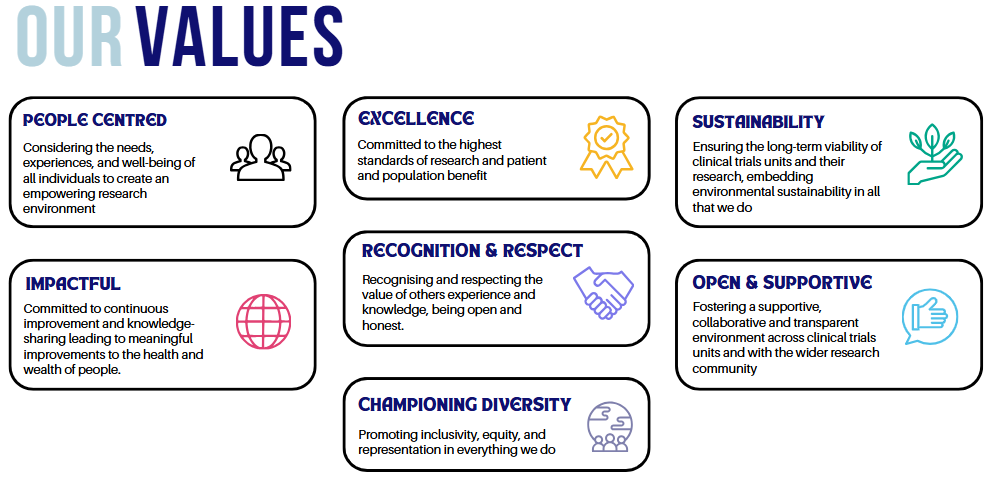
This is slightly different to our previous strategies – we have centred our values and clarified our value proposition as a network of highly experienced and innovative clinical trials units (CTUs). For me, as the new Network Director, having a clear set of values was important for the Network as everything we achieve is based on how we come together and create new ways of thinking, a common understanding, and the research culture of the future. How we then treat each other, and the broader communities we work with, is essential and reflects our commitments to respect and inclusion.  These will then drive a vibrant network in which we are able to challenge perceived wisdom and standards and support each other to move forward with new ways of doing things. Whilst these have been an integral part of our strategy development, I hope they will stand as the values of this network well past 2030 and continue to be a touchstone for our future.

But what are we actually going to be doing over the next five years? The field of clinical trials is rapidly moving, with major changes and developments in infrastructure across the UK.  For us, this means we need to focus on our collective approach to improving quality, efficiency and diversity in trials themselves, but also how we approach this in our governance, ways of working, and our workforce.  Sharing best practice and championing new approaches with sponsors and regulators is vital to see thorough uptake of new approaches.

We will continue to represent our member CTUs at a strategic and policy level and this has never been more important than now.  With a changing landscape for research globally, ensuring that academic trials that drive forward areas that are often not solved by industry have the infrastructure they need to deliver is vital.  We will also be exploring new ways of working in collaboration with industry to enhance the range of work undertaken and the ways in which it is done. However, an urgent priority for us is to ensure that the critical infrastructure provided by our members goes forward as a real strength of the research eco-system in the UK.  There are two ways in which we will address this – the first is to ensure we have a cohort of people coming through who can fill Director roles as people come up to retirement and the second is to develop our shared understanding of the best models to ensure sustainability of CTUs across a variety of types of host institutions (Universities, the NHS and Charities).

This strategy provides us with a focus to our activities and energy for the next five years, but also commits us to considerable effort to maintain and develop the health of this part of the research system which is internationally recognised as a driver of quality. As the person who sits in stewardship of this precious community of committed individuals and teams, I am enthused with what the next few years will bring and the direction this takes us.

You can learn more about the Network Strategy for 2025 – 2030 here.

Professor Kerry Hood
Director, UKCRC Registered CTU Network

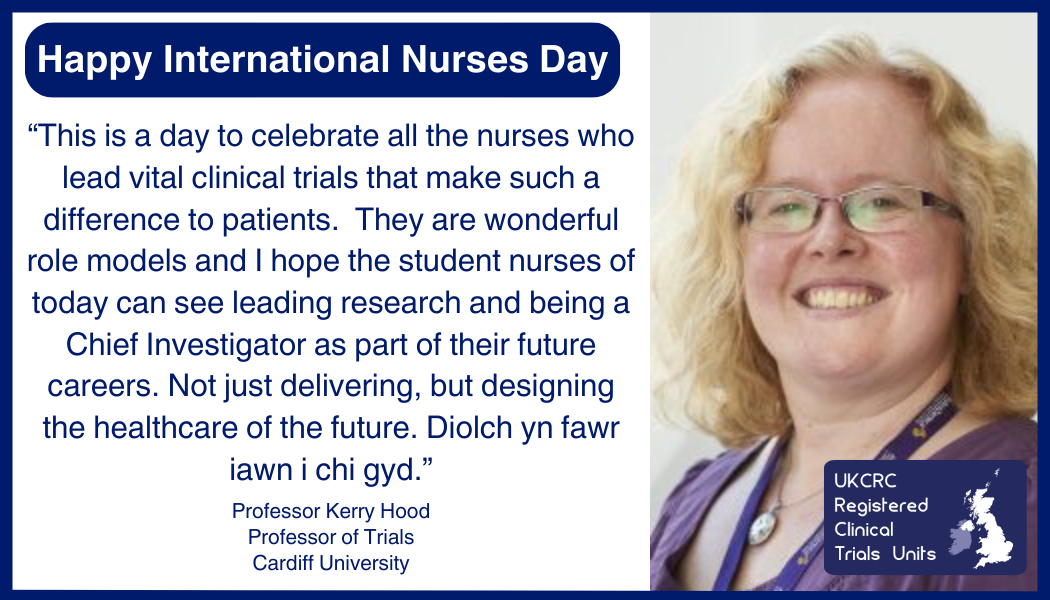
International Nurses Day – May 2023

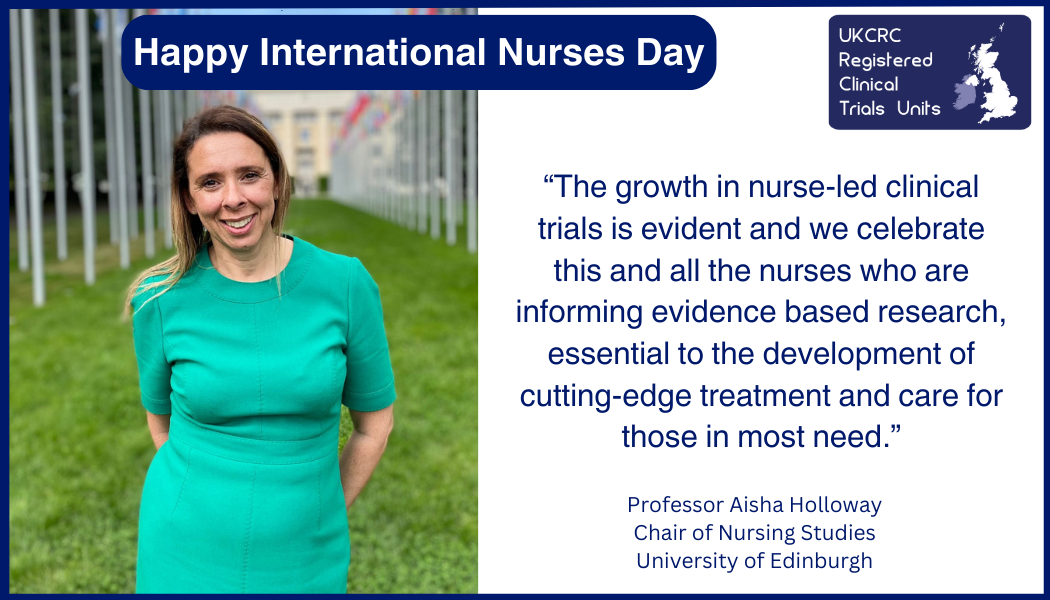
Nurses are the foundation of patient care across the globe, and their vital contributions cannot be overstated.

In 1974, the International Council of Nurses (ICN) established 12 May—Florence Nightingale’s birthday—as International Nurses Day. The day was created to highlight the invaluable work nurses do for patients and to shed light on key issues facing the nursing profession.

Each year, the ICN chooses a theme to reflect current priorities in health care. Past themes have included strengthening health system resilience, advancing health through nursing research, and promoting access and equity. In 2025, they are focusing on the importance of supporting the health and wellbeing of nurses whether that be physical, mental, emotional, or ethical.

Nurses also play an essential role in clinical research, both in the UK and internationally. They are integral members of interdisciplinary trial teams, supporting participants, contributing their own research ideas, and helping educate peers and the wider community. Research nurses are key to the successful delivery of clinical studies and the ongoing improvement of patient care.

We are proud to stand with our nursing colleagues and to amplify their voices.

You can find out more about the ICN and this year’s campaign here: www.icn.ch/.

Earth Day 2025

The UKCRC Registered CTU Network is pleased to celebrate Earth Day 2025, a day dedicated to environmental protection and sustainability. Earth Day, which began in the United States in 1970, became a global event in 1990, uniting people worldwide in the fight for a healthier planet.

Our Commitment to Sustainability

Over a number of years, the Network has supported work to identify and minimise the carbon footprint of clinical trials and promote a more sustainable approach both centrally and amongst our members.

In June 2024, we proudly became a supporter of the Concordat for the Environmental Sustainability of Research and Innovation Practice.

Sustainable Initiatives

As a network we have reduced the number of face-to-face national meetings we hold and transitioned to providing online meeting materials for all our events. 

We have increased the number of webinars, roundtables, and discipline-specific ‘clinics’ we host online, allowing more CTU staff to benefit from shared learning and peer-to-peer support without the need for travel. This shift not only reduces our environmental impact, but also significantly enhances accessibility.

Our Operations Groups work collectively to identify issues in their areas and find ways to mitigate against them. In August 2024, our Monitoring Group released a new resource aimed at helping Clinical Trials Units (CTUs) minimize the carbon footprint of their monitoring activities. Travel for on-site monitoring is a major contributor to the carbon footprint of clinical trials, for example, accounting for an estimated 10-15% of the total environmental impact. This work was highlighted in a debate in the House of Lords in March 2025, underscoring the importance of sustainability in clinical research.

A number of our member CTUs have taken part an initiative across the sector supported at various times by the NIHR and the TMRP to first quantify the carbon footprint of clinical trials, utilising the breadth and depth of leading trials expertise within CTUs to do so, complementing the knowledge brought by industry partners. More recently, they have developed tools to help researchers understand the impact of their intended trial protocol and make evidence-based decisions to minimise that impact.  These tools will be piloted across the Network.

Future Plans

We are also excited to announce the imminent release of our strategy for 2025-2030, which will embed environmental sustainability as a core value in all our activities.

As a Network, we foster collaboration among Clinical Trials Units (CTUs) to refine approaches, streamline processes, and share best practices. Our commitment to innovation and learning ensures that trials are designed and delivered with excellence, maximising impact while minimising waste.

Together, we can make a difference. Happy Earth Day 2025!

Generic trial animations available for use across the Network

At the end of 2022, three CTUs from the network (Oxford Clinical Trials Research Unit (OCTRU), Nottingham CTU, and Cardiff Centre for Trials Research received funding from the NIHR Efficient Clinical Trials Call for the EXPLAIN initiative (https://explain.octru.ox.ac.uk/). The EXPLAIN initiative was funded around the topic of Animated Explainer Videos (AEVs) – short videos/animations (up to 2 minutes) which can be used to help individuals understand more about taking part in a trial. 

The team surveyed the network about their use of AEVs and of the 35 CTUs that replied found that they had already been used by 24 CTUs.  AEVs were being used both for generic trial topics and also for the specifics of an individual trial to either explain the rationale for the trial or the interventions. For the 11 CTUs not using the technology at the time of the survey the most common reasons cited were a lack of expertise and lack of resources including the costs to produce them.

The EXPLAIN initiative funded the production of 3 AEVs on generic clinical trial topics in multiple languages to be made available free of charge to all CTUs across the network.  Through a modified Delphi survey, the EXPLAIN team also asked key trial stakeholders (including patients, site staff, and CTU staff trial) to rate generic trial topics which they thought would be useful to be produced into AEVs. 

The Delphi resulted in the creation of 3 AEVs, co-produced with patient partners who participated in the survey: What is informed consent? What is randomisation? and Safety in clinical studies.  All 3 AEVs are available in English, Welsh, Romanian, Polish, Panjabi, and what we think might be the first-time usage for such AEVs, in British Sign Language.  All are also available with subtitles in each of the languages.

To view the English versions of the animations please visit https://explain.octru.ox.ac.uk/animations.html and to request copies for any of your trials or CTU websites please complete the request form on that page.

The team will be looking at the usage of the animations – collecting metrics of their access and will also use a short questionnaire 12 months after creating individual links to each AEV to assess the usage and trial teams comments on the value of each AEV on their trial.

The EXPLAIN team wish to express their thanks to every CTU that responded to the survey, those that participated in the Delphi, and most important the PPI partners who co-produced the AEVs.  

form

Get in touch

If you have any questions about the site, please feel free to contact us. We are always looking for ways to better serve our members - YOU are important to us!

(0113) 3439132

    Sign up to newsletter